Rapid testing for thermally modified wood
Nathan Snizaski
Oct 4, 2026
Bingaman & Son Lumber, Inc. (Kreamer, PA) is one of the few US manufacturers of thermally modified lumber, a treated wood product that resists moisture and decay. Verifying that each batch of wood has been properly treated can take 30 days or longer. Bingaman partnered with researchers at Villanova University to identify a simpler, faster test that could help the company confirm that each batch has been properly modified and deliver a more consistent product to customers.
Thermally modified lumber is wood heated to high temperatures in a controlled environment and then allowed to cool, altering the wood's chemical structure. Its resistance to moisture and decay makes thermally modified lumber well suited for products such as siding, decking, and fencing.
“Thermal modification changes the structure enough that a lot of the insects and fungi that usually feed off wood don't really recognize it as wood any longer,” says Eric Musselman, associate professor of civil and environmental engineering at Villanova. “This makes it much more durable than standard untreated lumber, which makes it a wonderful material for exterior applications.”
Musselman served as the project’s principal investigator alongside co-PI David Dinehart, professor of civil and environmental engineering at Villanova. The research team also included two graduate students and three undergraduate students.
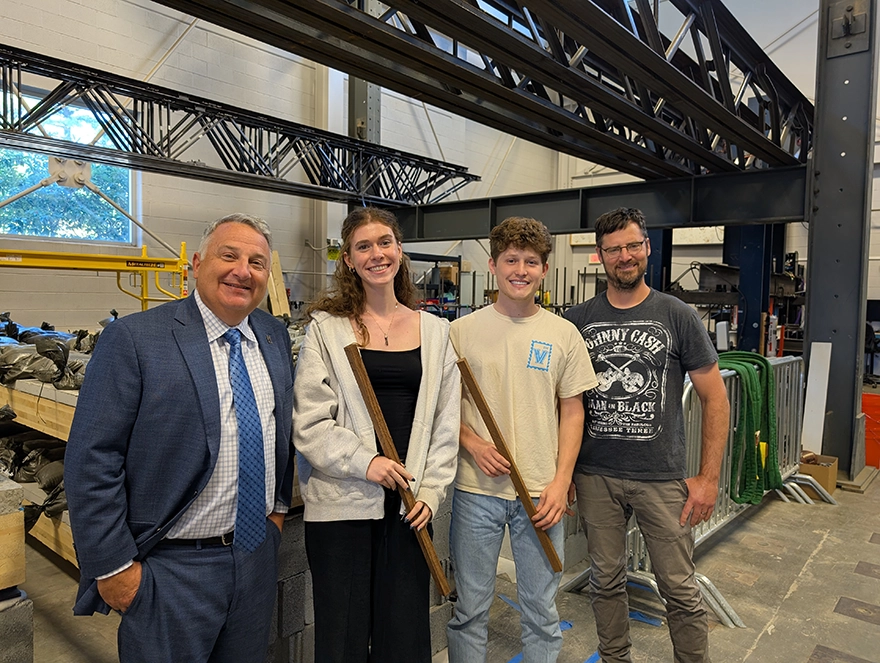
Research team (left to right): David Dinehart, Anneliese Liedtka (undergraduate student), Jacob O'Neil (master’s student), Eric Musselman.
One way to determine whether wood has been properly thermally modified is to measure its equilibrium moisture content (EMC)—the amount of moisture the wood holds when it reaches equilibrium with its surrounding environment. Because properly modified wood absorbs less moisture than untreated wood, EMC can indicate how effective the thermal modification process is. However, determining EMC is a lengthy process that can require about a month.
The Villanova team set out to identify a test that could provide results in one day or less, making it more practical for routine quality control. If researchers can identify a property that can be measured quickly, Bingaman could use it as a proxy for the month-long test.
To find a faster indicator, the team compared EMC with several mechanical and moisture-related properties across levels of thermal modification. Researchers measured characteristics such as strength, stiffness, water absorption, and expansion and contraction as moisture levels changed. They then compared those results with EMC to determine which properties most closely correspond with the level of thermal modification.
With a 24-hour turnaround, Bingaman can use this rapid test for quality control and address an issue before the product is shipped out the door–rather than finding it 30 days down the road.
Eric Musselman, associate professor of civil and environmental engineering, Villanova University
The team completed its first round of testing on red oak samples provided by Bingaman, comparing untreated wood with samples subjected to three different levels of thermal modification. Preliminary results show correlations between several measured properties and the level of thermal modification. So far, moisture-related measurements have shown the strongest correlation with EMC and the highest degree of statistical confidence.
“Right now, we have a high degree of confidence in the moisture content tests,” says Musselman. “We can run a rapid moisture content test in a day.”
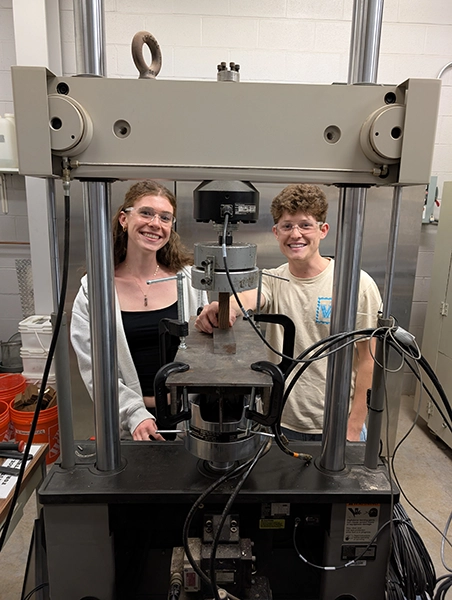
Villanova undergraduate Anneliese Liedtka (left) and master’s student Jacob O'Neil (right).
The researchers are also investigating whether strength properties could provide an even simpler way to verify thermal modification. Although moisture-related properties are more directly connected to durability, strength and stiffness are generally easier to measure and also change during thermal modification.
“While it's not directly related to durability, we could theoretically use strength as a proxy,” says Musselman. “If it's an indicator of thermal modification level, and it's an easier test to run, then that might be our best option to move forward.”
Beyond identifying a rapid quality-control test, the project is generating data on how thermal modification affects properties such as strength, stiffness, moisture absorption, and dimensional stability. The team's initial red oak testing represents the first part of a broader study of Pennsylvania hardwoods.
Ultimately, the researchers hope to turn their findings into a practical quality-control procedure that Bingaman can use during production.
“Bingaman can take a couple of samples from each batch, conduct what is hopefully a very quick, cost-effective test, and show that these properties are within the range we would expect for thermal modification, and confirm that this batch was done correctly.”
A rapid verification method could help Bingaman demonstrate the consistency of its thermally modified lumber while building consumer confidence in products made from sustainably sourced Pennsylvania hardwoods.
“Thermally modified wood for commercial products is relatively new, particularly in the US, so perhaps there is some hesitancy about the long-term durability and the quality of the product,” says Musselman. “If our work can improve confidence in the product, it could be a win for Bingaman & Son, and our research could have a big impact on the lumber industry within Pennsylvania.”